
The Human Cost of Missed Calls

Your phone rings while you’re working — under a sink, on a roof, three jobs deep. You can’t always get to it, and by the time you do call back, the caller has booked someone else.
This is how service businesses actually lose pipeline. Not bad reviews. Not pricing. The gap between the ring and a human voice on the other end — that’s where the leak is.
Pull your own call log from this month. Count the inbound calls that didn’t connect, then subtract the voicemails left. The remainder is your leak: calls where the customer dialed the next number and never thought about you again.
The problem
It isn’t that you’re busy.
Every service-business owner knows the squeeze. The phone buzzes while you’re elbow-deep in a job. You tell yourself you’ll call back — and you mean it. But by the time you’re back in the truck, the customer’s already booked with someone else.
The real problem isn’t your schedule. It’s the gap between “I need help now” and “someone picked up the phone.”
The numbers behind a missed call:
- Roughly 62% of calls to small businesses go unanswered during peak hours.
- Customers don’t leave voicemails — they hang up and call the next number on the list.
- The average service business loses 15–25 leads per week to missed calls alone.
Why traditional fixes don’t work.
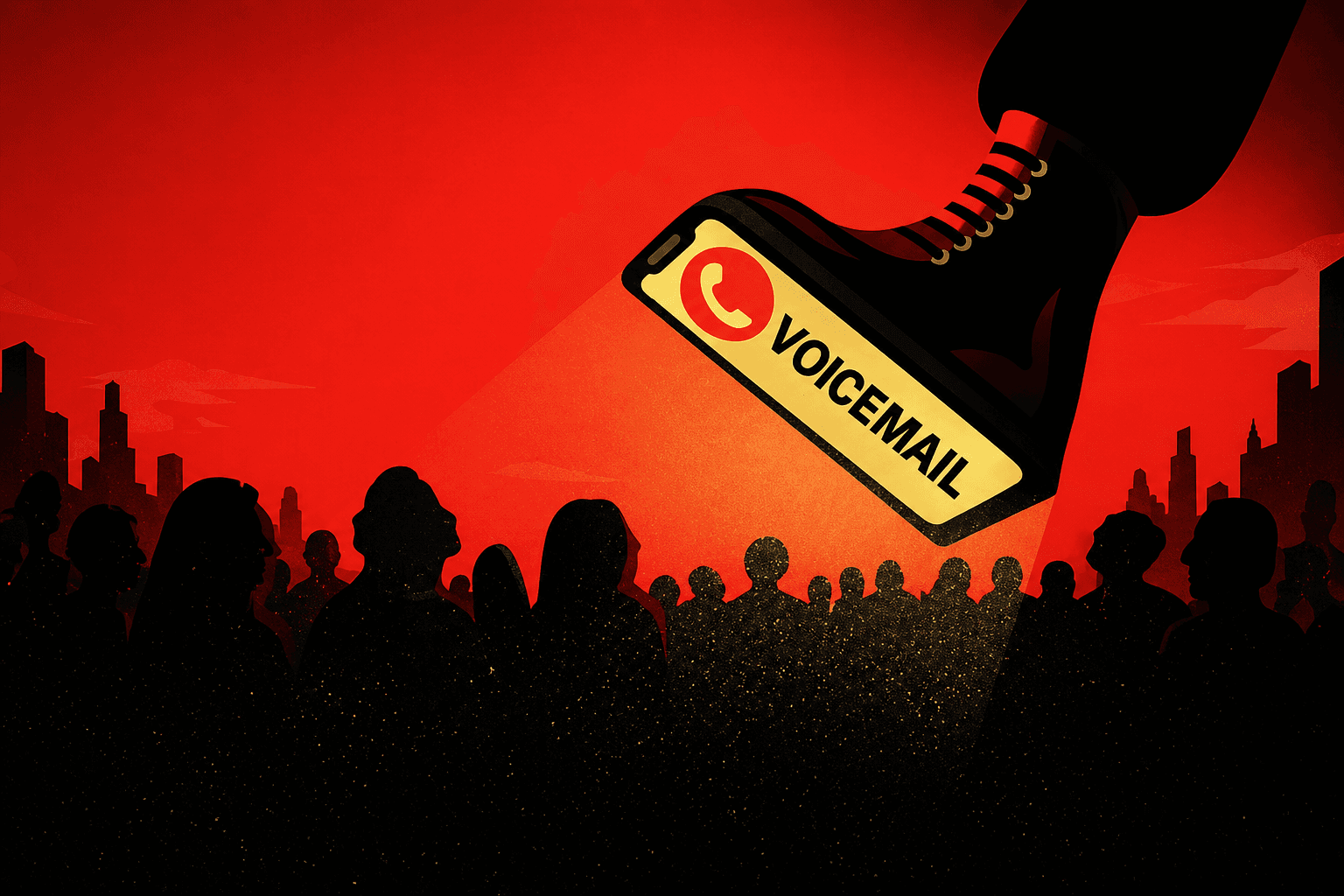
The crushing weight of voicemail.
What that sounds like
Six options. Two minutes. Zero answers.
Most callers don’t make it past the third option. On average, roughly two out of three customers will hang up on an automated phone system in frustration after failing to reach a human — and most don’t bother calling back.
“Please listen carefully — our menu options have changed…”
Voicemail
Voicemail is a wishlist of revenue you’ll never see. The callers who do leave a message wait for a callback — while three of your competitors’ phones ring once and pick up.
Human receptionists
A receptionist costs $40k+ a year, takes lunch, gets sick, and clocks out at 5pm. Your after-hours emergency call still goes to the same dead-end voicemail.
Generic AI receptionists
Most AI receptionists on the market are calendar-booking layers wrapped around a generic prompt. They’ll take a name and slot a time — but they’re not trained on your service catalog, your hours, what you don’t do, or how you actually price.
When a caller asks something specific — a quote on a particular service, whether you handle a particular make or model, what’s open next Saturday — the AI either guesses or hands the call off. Either response tells the caller this isn’t a real shop, and they dial the next number.
The compound cost
A missed call costs more than the job.
The customer who couldn’t reach you doesn’t leave a voicemail. They don’t add you to their callback list. They hire whoever picked up — and that becomes the shop they call for the next leak, the next breakdown, the next referral to a friend.
One missed call this week is the relationship that should have lasted five years. It’s the ten referrals that customer would have sent your way. It’s the five-star Google review sitting on your competitor’s page instead of yours.
The line item on your missed-call report is just the first dollar. The real damage compounds quietly — and it shows up in the year-end revenue gap you can’t quite explain.
What it looks like
What if your phone was always answered?
It’s 9pm on a Saturday. A homeowner’s AC just died, it’s 95 inside, and they’re calling every HVAC shop in town. Most go to voicemail. When they call your shop:
Hi, my AC stopped cooling and it’s 95 inside — do you do emergency service?
Yes — we have an on-call tech in your area. Can I grab your address and the make of your unit so they show up ready to fix it?
Sure — 1428 Pine, it’s a Carrier from about 2018.
Got it. Mike will be there in 35 minutes. I’ll text you a confirmation and his number — anything else I should let him know?
Just that the dog is in the back yard.
Noted — he’ll knock first. You’re all set.
Ninety seconds. Booked, confirmed, dispatched. The customer never heard a hold tone. Your on-call tech wakes up to a confirmed job with the make/model and a note about the dog.
Why Bunta
What makes Bunta different.
- Live in 10 minutes. Sign up, point your number, done. No 6-week onboarding.
- Trained on your services. Your prices, your hours, your team — not a generic template.
- Books on the spot. No callbacks, no missed second calls, no “we’ll get back to you.”
- Real-time team handoff. Urgent calls route to the on-call tech with the full context of the conversation.
- Automated follow-ups. Quote not closed? Bunta chases the lead for you with reminders and check-ins.
- Full call history. Every call transcribed and searchable in your dashboard — no audio recordings stored, just the conversation in plain text.
How Bunta actually runs your phone.
Forget “virtual assistant.” Forget call-center scripts. Bunta is a phone agent trained on your shop — your prices, your service area, your team, your no-go zones, your after-hours rules. Every call follows a clean arc — greet, qualify, answer, book, confirm — but the answers come from your business, not a generic template.
By the time the caller hangs up, the job is on the calendar, the right tech has the context they need to show up ready, and the customer has a confirmation in their inbox. You set the rules once. Bunta runs the phone while you run the day.
One dashboard
Every call, transcript, and booking in one place — searchable by customer, address, or keyword. No audio recordings, just the conversation in plain text.
A calendar that respects your day
Buffers between jobs. Travel time. Who’s on call tonight. Bunta books around your real schedule — never on top of it, never double-booked.
Follow-up that doesn’t quit
Quote not closed? Reminder not confirmed? Bunta texts the customer back automatically — the lead doesn’t just sit and rot in a queue.
What this looks like in your shop.
Home services
An after-hours burst-pipe call gets booked for 7am. Your plumber wakes up to a confirmed job — not a missed-call notification.
Auto
A new customer asking about brake pads gets a quote, the make/model logged, and a 9am slot on the books — all before the shop opens.
Wellness
A salon client books a cut and color while you’re mid-cut with someone else. No hold music, no lost walk-in.
The math
Run the numbers on your own shop.
Most service shops we talk to miss around ten calls a day — between trucks rolling, tools running, and the front office at lunch. At a $300 average ticket, here’s what those silent rings cost you in revenue you could have booked.
Drag any value to match your business. Numbers update instantly.
Plug your real numbers in above. Most owners are stunned at the annual figure — but the inputs aren’t ours. They come from independent industry research.
The volume is real. Across the trades, only about a third of inbound calls to small businesses get answered by a live person — the rest hit voicemail or ring out unanswered. Home-services categories — HVAC, plumbing, electrical — sit at the bottom of that range. Most callers don’t leave a message; they hang up and dial the next listing.
The booking rate is real. Industry averages across HVAC, plumbing, and electrical sit around 38–43% on answered calls. Recovered missed calls skew higher-intent (the customer actively chose to dial), so the 50% we assume for the recovered subset is a defensible floor for the math.
The ticket size is real. Average single-job tickets across HVAC, plumbing, and electrical generally run between $300 and $850 — with roofing and larger projects running well into four figures. The $300 we use in the calculator is deliberately the conservative low end, chosen so the math holds even for shops on the smaller side.
And speed matters more than most owners realize. The widely cited Lead Response Management findings show that firms that respond within five minutes are 21 times more likely to qualify the lead than those that respond in 30 minutes — and 60 times more likely than firms that wait 24 hours. After the first hour, the odds of even reaching the prospect collapse.
A phone that always answers, and books on the spot, doesn’t just recover missed revenue. It reaches the lead at the only window that actually matters — while they’re still on the line.